

What are the average incomes in Canada?

- As of 2024, the average income in Canada is $61,600 for those ages 15 and above.
- The median income in Canada is $44,400, which can be a more useful number since it isn’t impacted by very high and low incomes.
- Income can vary significantly by province or territory, city, age, industry and other factors tied to employment.
- What matters most is whether your income supports your fixed costs and savings goals.
- As your income changes, it’s important to revisit how much you’re saving and whether your investment mix still supports your goals.
Have you ever wondered how your income compares to other Canadians? Exploring the average income numbers can be a useful comparison tool, but they don’t tell the full story. Where you live, your stage of life, your job and your cost of living all affect how far your income goes. That’s why it helps to use income data as a benchmark, not a scorecard.
Looking at these numbers can help you understand what your income means for your day-to-day budget and your ability to save toward your financial goals. Here’s everything you need to know about the average income in Canada and how you can make the most of your money.
In this article
What is the average income in Canada?
As of 2024, the average income in Canada for people aged 15 and older is $61,600. That figure includes people from very different life stages, from students working part-time to experienced professionals in their peak earning years. That’s why it’s best to view this number as a broad benchmark rather than a target that applies to everyone equally.
It can be more useful to consider what your income allows you to do. After covering essential costs, do you have room to build an emergency fund, pay down debt or invest for your longer-term goals? Those questions can help turn a statistic into a practical planning conversation.

How does the average income in Canada differ by province and territory?
Average income varies significantly across the country, from $52,200 in New Brunswick to $83,200 in the Northwest Territories. Regional differences can reflect local industries, education levels and the cost of living. A higher average income in one province or territory doesn’t automatically mean residents in that area are making more money if housing, transportation and other fixed costs are also higher.
| Average income (2024) | ||
|---|---|---|
| Canada | $61,600 | |
| Alberta | $66,100 | |
| British Columbia | $63,300 | |
| Manitoba | $54,000 | |
| New Brunswick | $52,200 | |
| Newfoundland and labrador | $56,900 | |
| Northwest Territries | $83,200 | |
| Nova Scotia | $54,400 | |
| Nunavut | $65,100 | |
| Ontario | $63,200 | |
| Prince Edward Island | $52,400 | |
| Quebec | $58,700 | |
| Saskatchewan | $60,000 | |
| Yukon | $71,300 |
Source: Statistics Canada. Income of individuals by age group, sex and income source, Canada, provinces and selected census metropolitan areas.
City-level numbers add another layer of context. For example, incomes may be higher in Canada’s largest metropolitan areas, but so are everyday costs. Comparing only your gross income can mean missing the bigger question of purchasing power.
| Major cities | Average income (2024) | |
|---|---|---|
| Calgary | $69,900 | |
| Edmonton | $63,100 | |
| Montreal | $60,400 | |
| Ottawa-Gatineau | $68,900 | |
| Quebec City | $61,900 | |
| Toronto | $66,400 | |
| Vancouver | $65,600 | |
| Winnipeg | $55,000 |
Source: Statistics Canada. Income of individuals by age group, sex and income source, Canada, provinces and selected census metropolitan areas.
Cost of living: Why the same income can feel higher or lower
A salary that feels comfortable in one area may feel stretched in another, especially in expensive cities like Toronto and Vancouver. That’s why income benchmarks are most useful when compared to your personal cash flow: how much of your take-home pay is left over after covering essential costs?
In some areas, a lower salary can still mean stronger day-to-day affordability, while in others a higher salary may be needed just to maintain the same standard of living. When you look at the average, it’s important to keep the cost of living in mind so you’re comparing purchasing power, not just gross income.

What’s the average income in Canada by age?
Age can have a significant influence on how much you earn. Canadians aged 15 to 24 earn less on average at $20,900 a year, which reflects their often-limited work experience and education. In comparison, Canadians between the ages of 25 to 54 earn an average of $71,900 a year due to increased experience, seniority and specialized skills.
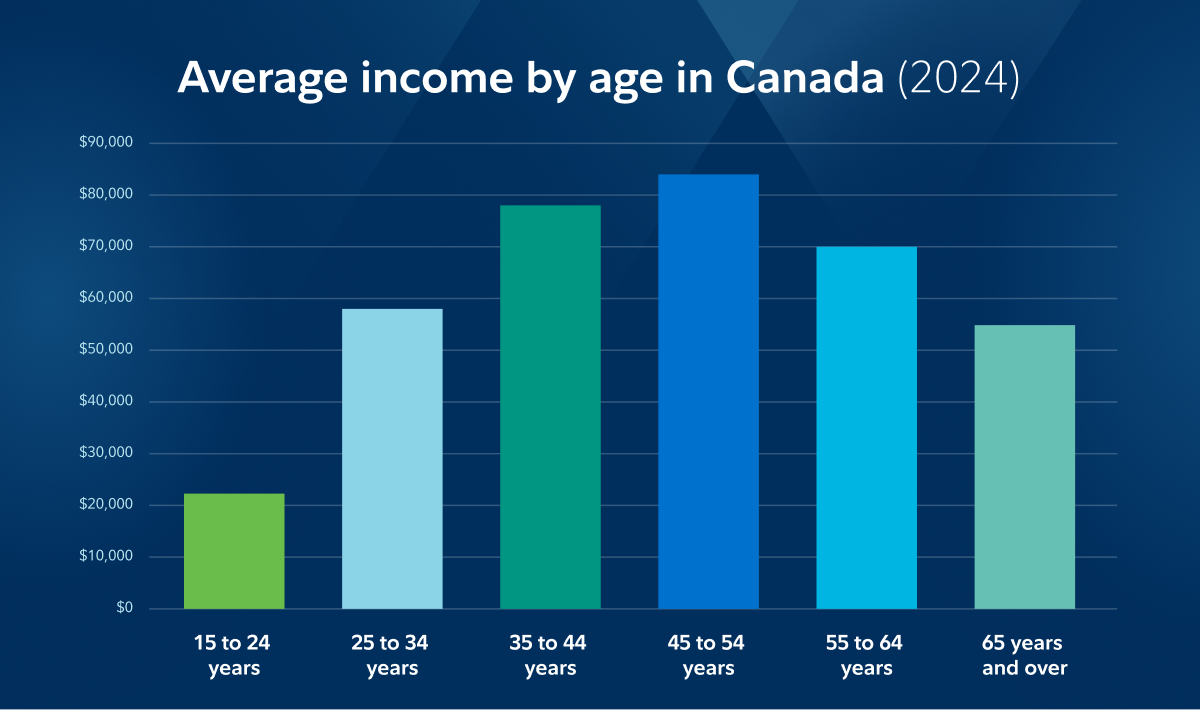
Source: Statistics Canada. Income of individuals by age group, sex and income source, Canada, provinces and selected census metropolitan areas.
Generally, earnings tend to rise as you gain experience. That’s why your peak earning years are especially important to plan for. This is often when tax-smart strategies, such as maximizing your RRSP contributions, can have the largest impact. A financial advisor can help you create a plan tailored to your unique situation and goals.

What is the median income in Canada?
The median income in Canada is $44,000 as of 2024. Median income represents the midpoint: half of Canadians earn more and half earn less. It can be a more practical comparison point because it’s less affected by a small number of extremely high-income earners or a large number of low-income earners.
Regardless of whether your income is above or below the median, what matters most is if your income supports your needs today while allowing you to make progress toward your future goals.
What are the highest-paying industries in Canada?
The industry you work in can also influence how much you make. Some sectors tend to pay higher wages because they require specialized education, skills or shift work. For example, salaries in Calgary and Edmonton are higher relative to the rest of the country because they have a disproportionate share of workers in the resources sector.
It can often be more useful to compare your income to the ranges within your field, region and experience level. Here’s a look at the top 10 highest-paying industries in Canada:
| Industry | Average hourly earning (2025) | |
|---|---|---|
| Mining, quarrying and oil and gas extraction | $70.30 | |
| Information and cultural industries | $55.36 | |
| Professional, scientific and technical services | $52.51 | |
| Goods producing industries | $50.80 | |
| Finance and insurance | $49.75 | |
| Industrial aggregate (excluding unclassified businesses) | $47.46 | |
| Construction | $47.45 | |
| Service producing industries | $46.97 | |
| Manufacturing | $45.66 | |
| Real estate and rental and leasing | $44.06 |
Source: Statistics Canada. Average hourly earnings (including overtime) for salaried employees, by industry, annual.
How you can earn more money over time
Knowing where you stand relative to the averages is a good starting point. If you’re looking to raise your current earnings, there are a few practical options to consider.
Work toward a raise or promotion
A good place to start is to focus on what you already know. Negotiating a salary increase based on your contributions and market data is a reasonable step, especially if salary data for similar roles suggests you’re below the typical rate. While you’re having that discussion, you may ask your manager for guidance on what skills or experience would help you earn a promotion. That clarity can help turn a single conversation into a longer-term plan.
Increase your education and skills
Further education in your current field can help you earn a higher wage that better reflects your skill level. In some cases, it may be worth retraining in a higher-paying field.
The Lifelong Learning Plan (LLP) can help you cover the cost. This program allows you to make tax-free withdrawals from your Registered Retirement Savings Plan (RRSP), up to $10,000 per year and a lifetime maximum of $20,000, to fund full-time education or training. Repayment rules apply, so it’s important to review the details before making a withdrawal.
Invest your money for passive income
Investing can be another way to grow your money, even without increasing what you earn from work. A portfolio that includes dividend-paying funds or fixed-income investments can be a lower-risk way to invest while generating additional income. The longer your money stays invested, and the more you reinvest what it earns, the more time you have to benefit from the power of compounding.
Leverage tax-advantaged accounts
Where you invest matters too. There are several registered accounts available in Canada that can help you save toward your various goals.
- Registered Retirement Savings Plan (RRSP): This account can help you save toward retirement with tax-deductible contributions and tax-deferred investment growth.
- Tax-Free Savings Account (TFSA): This account can be used for any savings goal, offering flexibility. It provides tax-free withdrawals and investment growth.
- First-Home Savings Account (FHSA): This account aims to help first-time homebuyers save for their first home. It combines the perks of an RRSP and TFSA, offering tax-deductible contributions and tax-free withdrawals for a qualifying home purchase.
- Registered Education Savings Plan (RESP): This account allows parents and loved ones to save toward a child’s post-secondary education, offering tax-deferred investment growth.

The bottom line
Exploring the average income figures in Canada can help you understand the broader economic picture, but it’s only one part of your financial story. Your location, age, industry, taxes and cost of living all affect what your income means in practice.
As your income grows, it’s worth thinking about how much of it you’re saving toward your future goals. Even modest increases in what you save and invest each year can make a big difference over the long term.
FAQs
Which province has the lowest income in Canada?
New Brunswick has the lowest average income in Canada at $52,200 a year.
What’s the highest-paying industry in Canada?
Mining, quarrying and oil and gas extraction is the highest-paid industry in Canada, with workers earning an average of $70.30 per hour. That works out to be roughly $140,600 a year for a full-time salary.
What’s considered a good income in Canada?
A “good” income depends on where you live, your household size, your debt, your goals and your cost of living. Instead of focusing on one number, it can be more helpful to compare your income with your essential expenses, savings and progress toward your goals.
Which province has the highest average income in Canada?
The Northwest Territories has the highest average income among provinces and territories in Canada, at $83,200 as of 2024.
How should you use income data when planning your finances?
Income data can be used as context, helping you benchmark earnings. But the more important planning questions are how much you keep after taxes and expenses, how consistently you save and whether your account choices and investments align with your goals.