
ETF Round Up: Insights from Etienne Joncas-Bouchard - February 18, 2026
January delivered the strongest month on record for the Canadian ETF industry, with investor demand staying broad-based and international exposure leading the way as markets continued to broaden. Fidelity’s Director of ETF and Alternative Strategy, Étienne Joncas-Bouchard, unpacked what is driving the surge in flows, why market breadth is improving and how factor leadership is shifting.
Canadian ETF market momentum and growth
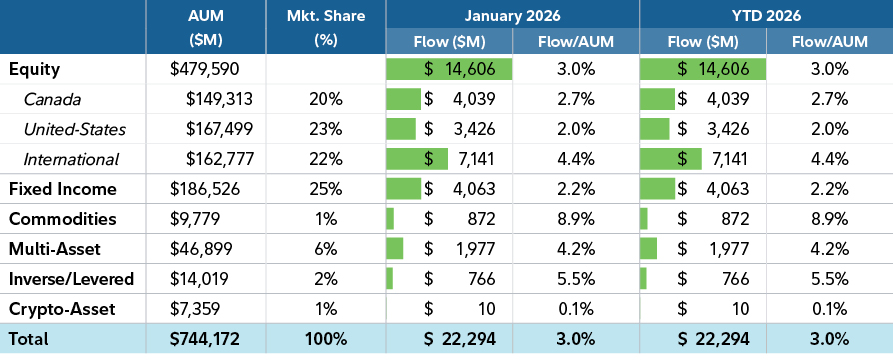
Canadian ETFs pulled in roughly $22 billion in net new assets in January, setting a new monthly record and extending the strong run the industry has seen over the past several years. Equities led the way at around $14 billion, while fixed income remained more subdued at roughly $4 billion, with part of that total influenced by a few large institutional trades, including sizable flows into a TIPS ETF. One of the biggest highlights was demand for international equities, which brought in about $7 billion, roughly matching the combined total of Canada and the U.S. equity categories. A notable milestone also emerged: there are now more assets in international equity ETFs in Canada than in Canadian equity ETFs, a sign of how much global diversification has become embedded in the ETF toolkit.
Canadian ETF industry trends - Asset class - Net flows ($M)
Market breadth improves as leadership expands
After several years of narrow leadership, Étienne noted that market breadth has improved meaningfully. The share of stocks outperforming the broad benchmark has moved closer to 65%, versus a historical average near 55%, and far above the roughly 30% levels seen during the prior stretch of concentrated market performance since 2023. He also pointed to weaker recent performance from several hyperscalers and mega-cap names, noting that five of the Magnificent Seven have underperformed since the start of 2025, with Alphabet and Nvidia cited as exceptions. This “bullish broadening” matters because it can create more room for systematic and factor-based approaches to add value when returns are not dominated by a small handful of index heavyweights.
All-in-One ETFs and the role of diversification
Fidelity’s All-in-One ETF portfolios have been a major driver of flows, accounting for about 60% of Fidelity ETF flows so far this year. The lineup spans a range of risk profiles, from 100% fixed income to about 97% equities with a 3% Bitcoin allocation. Étienne emphasized that these portfolios are designed to be globally diversified and strategic, not built around tactical asset allocation calls. Instead, the approach seeks to add value over time through the underlying factor and stock-selection process. He also highlighted how, across calendar years, different components have driven results at different times, reinforcing the case for broad diversification rather than relying on a single theme to carry performance.
Factor strategies and what is changing now
Fidelity’s framework combines value, quality, momentum and low volatility, with the goal of capturing diversification benefits and the long-run strengths of each factor across a full business cycle. So far this year, he noted a strong start with three out of four factors outperforming in the U.S. and International regions. Over longer horizons, he referenced back tested results showing that, on average, the number of factors outperforming in a given year tends to be around 2.5 in Canada and the U.S. and closer to 3 in International markets. He also flagged that a major factor rebalance is scheduled for February 20, 2026, which can shift exposures as fundamentals and valuations evolve.
Value, momentum and international opportunity
Étienne reiterated that value can act as a useful diversifier, and he suggested prospects look better than they did a couple of years ago as economic activity appears to be bottoming and valuation discounts remain meaningful. He also noted that areas like software and consumer discretionary have become cheaper, which could make them more interesting to watch through the upcoming rebalance, even as business model questions around AI evolve.
On international equities, he pointed to two supportive forces: continued demand for global exposure and the ongoing valuation gap, with international developed markets still trading at a discount to the U.S. even after last year’s outperformance. He also highlighted areas of opportunity discussed by Fidelity managers, including Japan, while noting that some trades, such as financials, may be more stretched.
Final thoughts
Record-setting January ETF flows, improving market breadth and shifting factor leadership are reinforcing a consistent message: diversification and a disciplined, multi-factor approach can help investors stay invested as leadership changes. In a market where themes can rotate quickly, combining factors and maintaining broad exposures can provide a steadier framework for navigating what comes next.