
ETF Round Up: Insights from Etienne Joncas-Bouchard - December 10, 2025
The Canadian ETF industry is closing out 2025 on a strong note, with ETF flows hitting record highs and market dynamics shifting in unexpected ways. Equity demand surged, regional allocations evolved and factor-based strategies continued to shape portfolio construction. As we look toward to 2026, diversification and disciplined positioning remain essential themes for advisors and clients navigating an environment where leadership may change quickly.
Canadian ETF market momentum and growth
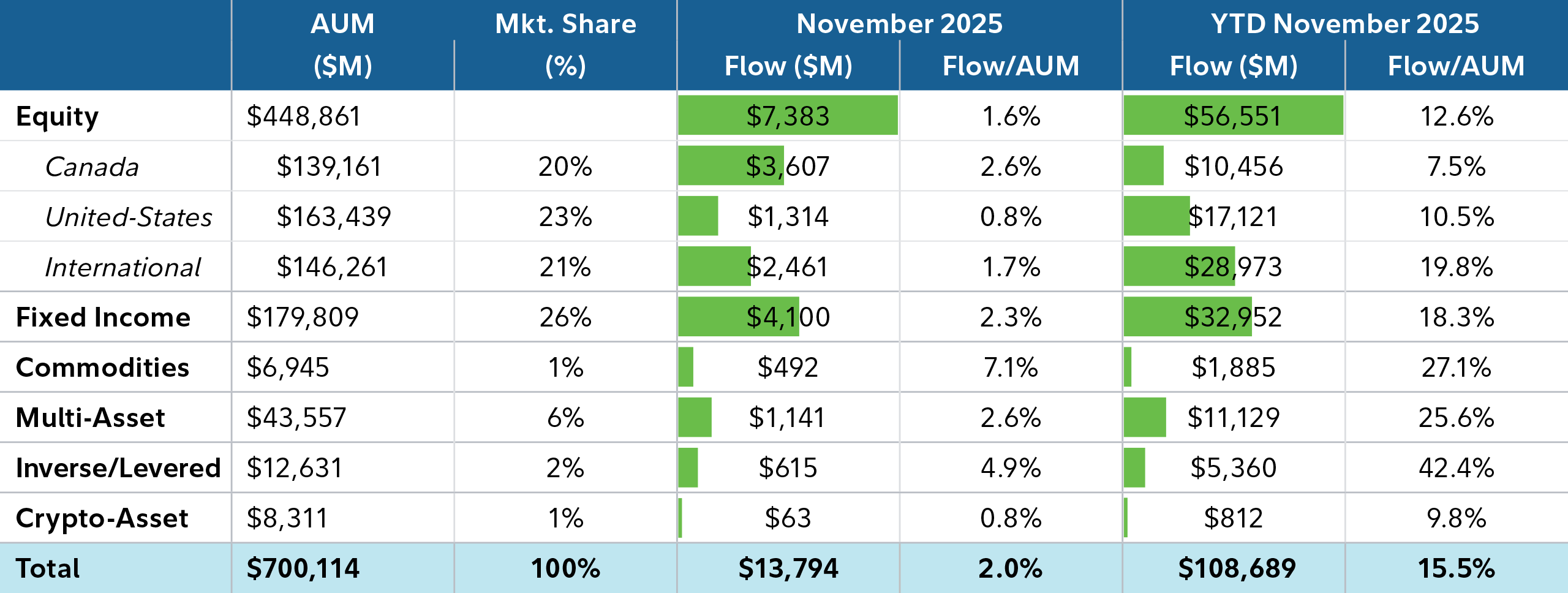
November marked a milestone for Canadian ETFs, contributing to a record $109 billion in net new assets for the year. Equity ETFs dominated inflows, reflecting a clear risk-on sentiment. While fixed income demand was subdued, gold ETFs attracted more than $1 billion year-to-date, despite slowing in November. Another notable trend was the rise of inverse and leveraged products, doubling in size this year, driven largely by retail investors seeking higher risk or enhanced income.
Canadian ETF industry trends - Asset class - Net flows ($M)
Canada and international markets shine
For years, U.S. equities led the pack, but this year told a different story. Canadian equities staged a comeback, accounting for nearly half of November’s equity ETF inflows. International markets also gained traction, supported by themes like infrastructure investment and fiscal expansion. These trends align with early- to mid-cycle characteristics, where sectors such as industrials and financials have outperformed. In Canada, commodities played a pivotal role, precious metals alone contributed roughly 30% of TSX returns this year. Looking ahead, a stronger commodity cycle could provide additional tailwinds, though outcomes will depend on broader market conditions.
Factor strategies drive portfolio design
Fidelity’s multi-asset solutions and regional equity ETFs are built on four core factors: value, quality, momentum and low volatility. Combining these factors provides diversification and reduces reliance on market timing. While momentum has dominated for nearly three years, recent rebalancing shows a tilt toward value and quality, particularly outside the U.S. This approach helps portfolios capture strategic opportunities over time, even as factor leadership rotates.
Bitcoin’s role in diversification
Including Bitcoin in multi-asset portfolios remains a distinctive choice. Beyond its volatility, Bitcoin offers diversification benefits and acts as a levered equity proxy, helping portfolios align with main competitor risk profiles. Interestingly, Fidelity’s All-in-One ETFs often outperform during Bitcoin downturns, highlighting its counterintuitive role in balancing portfolio dynamics. The allocation isn’t about chasing past performance, it’s about enhancing diversification and positioning for long-term technological relevance.
Positioning for 2026: Momentum and value
As we look ahead, momentum remains a strong theme, supported by favorable macro conditions and potential dovish moves from central banks. Quality names in the U.S. also appear well-positioned, with solid profitability and attractive relative valuations. International markets may see value strategies thrive as themes like infrastructure investment and fiscal expansion play out. While mega-cap tech continues to command attention, questions around sustainability of outsized earnings growth suggest a more balanced approach could deliver resilience in the year ahead.
Final thoughts
The investment landscape is evolving, and so are the strategies to adapt. Record ETF inflows renewed interest in Canadian and international equities, and the integration of factor-based and alternative allocations underscore the importance of diversification. For advisors and investors, the message is clear: a disciplined, multi-factor approach—complemented by tactical enhancements, offers a robust framework for capturing opportunities in 2026 and beyond.