
Acting despite uncertainty
In this article
One of your authors used to participate in Bank of Canada interest rate deliberations. Every time, one participant in those deliberations asserted that uncertainty was higher than normal, suggesting that a decision should be deferred pending additional information. This used to frustrate your author greatly. Uncertainty can’t always be higher than normal, by definition. And even if it is, that doesn’t justify inaction to await greater clarity which may never come (noting also that leaving rates unchanged is itself a decision).
In current circumstances, however, we don’t think it’s a stretch to say that uncertainty is higher than normal, for policymakers and investors alike. The big macro market issues – AI bubble/not bubble and the Iran and trade wars – are subject to a very wide range of outcomes which, in our view, will be driven by essentially uncallable factors. But as above, this does not absolve us of the responsibility to make the best decisions possible for the shareholders in our funds. The best decision is never to cower under a rock, but rather to evaluate how the market is weighing the uncertainty and use that analysis to manage the risks and pursue the opportunities that both tend to be more pronounced in periods of elevated uncertainty. Below we detail how we’re doing that in our active asset allocation positioning.
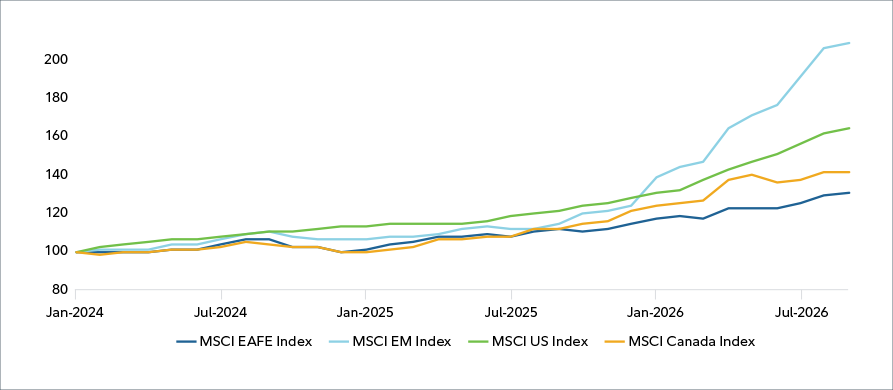
EXHIBIT 1: Earnings explosion
Source: Fidelity, Macrobond, as of August 31, 2026.
Earnings growth since January 2024.
Maintaining a (Smaller) Equity Overweight
We prefer stocks to bonds but have reduced the size of our equity overweight in recent months. Our top‑down macro inputs generally remain supportive of stocks, notably strong economic growth and a shift from labour to capital income (discussed in our last paper) that is resulting in explosive earnings growth (Exhibit 1). We are less worried than many about the impact on equities of higher bond yields, seeing them primarily as a reflection of that strong growth (see next section).
However, some of the bottom‑up signals are starting to fray somewhat. Most notable among these is the AI theme, where our analysts and portfolio managers who are closest to the companies building and deploying this technology have become more cautious. In their assessment, the capital expenditure planned to build the AI infrastructure requires a potentially unrealistic bar for future revenue to clear to ensure profitability. Moreover, both the pace of AI development and adoption may be challenged by increased government regulation and populist backlash.
To be clear, we believe the long‑term potential of AI is considerable, but history shows that the development of transformational technologies never moves in a straight line. And given the significant influence that the AI theme exerts over many asset classes, our response to a more cautious near‑term outlook is to trim our equity overweight, particularly those most correlated with AI.
A second bottom‑up signal that warrants some caution is that the market consensus has largely caught up to our internal expectations for corporate earnings. Our Fidelity analysts’ consistent view in recent years that companies would outearn even lofty market expectations has been critical in keeping us in an overweight equity position through the bouts of volatility. But market expectations appear to have caught up with our analysts more recently, warranting a reduction in our risk stance.
Higher Yield Regime = Underweight Duration
We remain underweight fixed income duration and continue to prefer to hold credit and other spread sectors relative to investment grade fixed income. We believe the recent increase in government yields is largely due to a strong rise in demand for investment dollars. In the private sector, this demand is required to fund the buildout of AI related infrastructure. Meanwhile, the public sector requires considerable sums to fund massive and growing fiscal deficits. To attract investors and ensure demand for funds is met by supply, governments and companies must offer higher interest rates to prospective lenders. We think that these trends in both the private and public sectors will persist. And so long as the wider economy remains reasonably healthy, we believe that yields will remain elevated.
A growing number of central banks have also begun to tighten monetary policy, putting further upwards pressure on yields. Economic growth remains strong and the combination of continued AI investment, stimulative fiscal policy, and ongoing geopolitical tensions is expected to keep inflation stubbornly elevated. Making matters worse, the efforts of an increasingly activist US Treasury to lean against the market and suppress borrowing costs are threatening the credibility of the institution, further prompting investors to demand higher yields to hold US government debt.
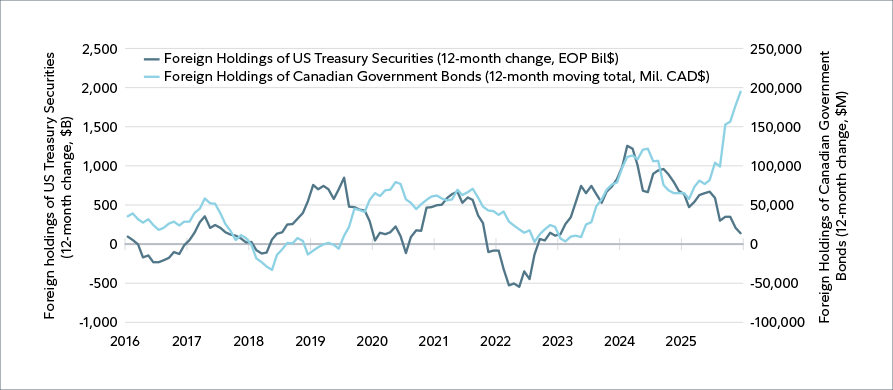
Given all these concerns, we remain underweight investment grade bonds. We have also materially shifted the profile of our fixed income holdings, reducing our holdings of the riskier‑looking US bond market in favour of other markets, including Canada; other market participants have been doing the same (Exhibit 2).
In a riskier bond environment, we must look further afield for diversifiers. Allocations to commodities (including gold) and select alternatives all serve this purpose. In addition, the diversification value of assets in Canada looks increasingly attractive.
Staying Overweight Canadian Assets
As noted above, we believe making a high conviction call on the ultimate fate of AI is effectively impossible at this stage. In that context, we want exposure to both the AI theme and to those markets that can do better if the excitement about AI fades. Canada fits the bill on the latter. While there are a handful of companies exposed to AI in Canada, the large weight that resources and financials have in the TSX makes the overall index much less correlated with the technology sector in the US and other markets.
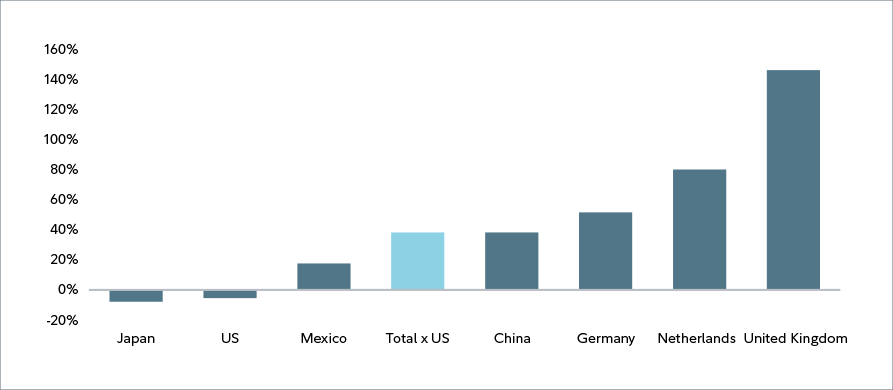
In addition to being one of the least correlated markets to AI, our overweight to Canada reflects a strengthening economy and a durable tailwind from firmer commodity prices. Real GDP growth has rebounded strongly from its late 2025 doldrums, and our modeled probability of recession has retreated sharply despite the ramping up of the trade war with the United States. While the risk of a further escalation in trade tensions bears close monitoring, we have seen a broadening in exports and a strengthening of trade ties with a growing list of countries outside of North America (Exhibit 3).
Beyond international trade, the inaugural Canadian Investment Summit 2026 led to a number of high‑profile policy announcements that prioritize public and private sector investment in projects that will support many parts of the Canadian economy. The summit builds on a number of other recent policy announcements focused on transportation and infrastructure projects related to the natural resources sector.
EXHIBIT 2: Investors increasingly favouring Canadian bonds
Source: Fidelity, Bloomberg, as of July 2026.
These domestically driven initiatives pair well with many economies around the world looking to secure strategically important natural resources.
The success of policymakers in diversifying trade, building critical infrastructure, and boosting productivity hinges on the execution over a long horizon. But we are encouraged in the interim by our analysts who cover Canadian companies who report that these policies have been favourably received and are expected to translate into spending and investment activity. Many of our colleagues on Fidelity’s Global Asset Allocation team (who primarily manage funds for US investors) have also viewed these developments positively and have increased their allocation into Canadian assets over the last year.
The confluence of factors coming together in support of Canada is remarkable. The retreat of globalization amid an increasingly fractured global economy has been met by proactive policymakers who see the opportunities ahead. We saw some of these preconditions for growth falling into place when we began trimming our underweight to Canadian assets more than a year ago. Our confidence has grown since and today we sit, in many of our funds, with the largest overweight to Canada we have had in over a decade. To be sure, domestic economic conditions remain challenging in Canada and probably will remain so for some time. But there is a path to better for the first time in a long time, a path only gradually becoming appreciated by investors globally. Just as the country cannot sit still as it navigates its way through an exceptionally uncertain world, we too will remain active in following our investment process to seek return and manage risk for the shareholders in our funds.
EXHIBIT 3: Developing diversification
Total goods domestic exports by destination, % change from December 2024
Source: Fidelity, Statistics Canada, as of July 2026.

Authors:
David Wolf l Portfolio Manager
David Wolf is a Portfolio Manager for Fidelity Investments. He is the co–manager of Fidelity Managed Portfolios, Fidelity Global Equity+ Fund, Fidelity Global Equity + Balanced Fund, Fidelity Canadian Asset Allocation Fund, Fidelity Canadian Balanced Fund, Fidelity Monthly Income Fund, Fidelity U.S. Monthly Income Fund, Fidelity Global Monthly Income Fund, Fidelity Global Dividend Fund, Fidelity Income Allocation Fund, Fidelity American Balanced Fund, Fidelity Conservative Income Fund, Fidelity NorthStar®, Fidelity NorthStar® Balanced Fund, Fidelity CanAm Opportunities Class, Fidelity Inflation-Focused Fund, Fidelity Canadian Monthly High Income ETF Fund, Fidelity Global Monthly High Income ETF Fund and Fidelity Tactical Global Dividend ETF Fund. He is also portfolio co‑manager of Fidelity Conservative Income Private Pool, Fidelity Asset Allocation Private Pool, Fidelity Balanced Private Pool, Fidelity Balanced Income Private Pool, Fidelity U.S. Growth and Income Private Pool, Fidelity Global Asset Allocation Private Pool and Fidelity Global Asset Allocation Currency Neutral Private Pool.
David Tulk, CFA l Portfolio Manager
David Tulk is a Portfolio Manager for Fidelity Investments. He is the co manager of Fidelity American Balanced Fund, Fidelity Asset Allocation Private Pool, Fidelity Balanced Income Private Pool, Fidelity Balanced Portfolio, Fidelity Global Equity + Balanced Fund, Fidelity Balanced Private Pool, Fidelity Canadian Asset Allocation Fund, Fidelity Canadian Balanced Fund, Fidelity Canadian Monthly High Income ETF Fund, Fidelity Conservative Income Fund, Fidelity Conservative Income Private Pool, Fidelity Conservative Managed Risk Portfolio, Fidelity Global Asset Allocation Private Pool, Fidelity Global Balanced Portfolio, Fidelity Global Dividend Fund, Fidelity Global Equity Portfolio, Fidelity Global Growth Portfolio, Fidelity Global Growth Private Pool, Fidelity Global Income Portfolio, Fidelity Global Monthly High Income ETF Fund, Fidelity Global Monthly Income Fund, Fidelity Growth Portfolio, Fidelity Income Allocation Fund, Fidelity Income Portfolio, Fidelity Inflation-Focused Fund, Fidelity Monthly Income Fund, Fidelity NorthStar® Balanced Fund, Fidelity Tactical Global Dividend ETF Fund, Fidelity U.S. Growth and Income Private Pool and Fidelity U.S. Monthly Income Fund
Ilan Kolet l Institutional Portfolio Manager
Ilan Kolet is an Institutional Portfolio Manager for Fidelity Investments. In this role, Mr. Kolet serves as a member of the investment management team, maintaining a deep knowledge of portfolio philosophy, process and construction. He assists portfolio managers and their CIOs in ensuring portfolios are managed in accordance with client expectations.
Bruno Crocco, CFA l Portfolio Manager
Bruno Crocco is a Portfolio Manager for Fidelity Investments. He is the co–manager of the Fidelity ClearPath Retirement Portfolios, Fidelity ClearPath Institutional Portfolios and Fidelity ClearPath Index Plus Portfolios. He is also the co-manager of the Tactical Asset Allocation suite and other multi-asset strategies for Canadian investors.
Jon Knowles, CFA l Institutional Portfolio Manager
Jon Knowles is an Institutional Portfolio Manager for Fidelity Investments. In this role, Mr. Knowles serves as a member of the investment management team, maintaining a deep knowledge of portfolio philosophy, process and construction. He assists portfolio managers and their CIOs in ensuring portfolios are managed in accordance with client expectations.
Commissions, trailing commissions, management fees, brokerage fees and expenses may be associated with investments in mutual funds and ETFs. Please read the mutual fund or ETF’s prospectus, which contains detailed investment information, before investing. The indicated rates of return are historical annual compounded total returns for the period indicated including changes in unit value and reinvestment of distributions. The indicated rates of return do not take into account sales, redemption, distribution or option charges or income taxes payable by any unitholder that would have reduced returns. Mutual funds and ETFs are not guaranteed. Their values change frequently, and investors may experience a gain or a loss. Past performance may not be repeated.
The index returns are shown for comparative purposes only. Indexes are unmanaged, and their returns do not include any sales charges or fees as such costs would lower performance. It is not possible to invest directly in an index.
From time to time a manager, analyst or other Fidelity employee may express views regarding a particular company, security, and industry or market sector. The views expressed by any such person are the views of only that individual as of the time expressed and do not necessarily represent the views of Fidelity or any other person in the Fidelity organization. Any such views are subject to change at any time, based upon markets and other conditions, and Fidelity disclaims any responsibility to update such views. These views may not be relied on as investment advice and, because investment decisions for a Fidelity Fund are based on numerous factors, may not be relied on as an indication of trading intent on behalf of any Fidelity Fund.
Certain Statements in this commentary may contain forward-looking statements (“FLS”) that are predictive in nature and may include words such as “expects”, “anticipates”, “intends”, “plans”, “believes”, “estimates” and similar forward-looking expressions or negative versions thereof. FLS are based on current expectations and projections about future general economic, political and relevant market factors, such as interest and assuming no changes to applicable tax or other laws or government regulation. Expectations and projections about future events are inherently subject to, among other things, risks and uncertainties, some of which may be unforeseeable and, accordingly, may prove to be incorrect at a future date. FLS are not guarantees of future performance, and actual events could differ materially from those expressed or implied in any FLS. A number of important factors can contribute to these digressions, including, but not limited to, general economic, political and market factors in North America and internationally, interest and foreign exchange rates, global equity and capital markets, business competition and catastrophic events. You should avoid placing any undue reliance on FLS. Further, there is no specific intention of updating any FLS whether as a result of new information, future events or otherwise.
“Fidelity Investments” and/or “Fidelity” refers collectively to: i) FMR LLC, a US company, and certain subsidiaries, including Fidelity Management & Research Company (FMR Co.) and Fidelity Management & Research (Canada) ULC (“FMR-Canada”) – which carries on business in British Columbia as FMR Investments Canada ULC; and ii) Fidelity Investments Canada ULC (“FIC”) and its affiliates. Fidelity Management & Research (Canada) ULC (“FMR-Canada”) commenced business in Ontario on February 1, 2018. FMR-Canada is registered as a portfolio manager with the Ontario Securities Commission (“OSC”) and as a portfolio manager with the other Canadian securities commissions. The scope of FMR-Canada’s business is currently limited to offering the Global Asset Allocation (“GAA”) strategies through a discrete portfolio management team at FMR-Canada. The GAA strategies are offered by FMR-Canada on a sub-advised basis to accounts advised by Fidelity Investments Canada ULC (“FIC”), with FMR-Canada acting as either direct sub-adviser to FIC or as sub-sub-adviser through non-Canadian Fidelity advisers, including (and principally) US SEC-registered investment advisers, such as FMR Co., Inc. (“FMRCo”). FMR-Canada does not offer these strategies directly to investors in Canada. FMR-Canada has also registered “Fidelity Investments” as a trade name in Canada.
The statements contained herein are based on information believed to be reliable and are provided for information purposes only. Where such information is based in whole or in part on information provided by third parties, we cannot guarantee that it is accurate, complete or current at all times. It does not provide investment, tax or legal advice, and is not an offer or solicitation to buy. Graphs and charts are used for illustrative purposes only and do not reflect future values or returns on investment of any fund or portfolio. Particular investment strategies should be evaluated according to an investor’s investment objectives and tolerance for risk. Fidelity Investments Canada ULC and its affiliates and related entities are not liable for any errors or omissions in the information or for any loss or damage suffered.
© 2026 Fidelity Investments Canada ULC. All rights reserved. Fidelity Investments is a registered trademark of Fidelity Investments Canada. The presenter is not registered with any securities commission and therefore cannot provide advice regarding securities.
INM 5070150 10/08 5102800-v2026101